XIAM007

Making Unique Observations in a Very Cluttered World

Monday, 1 April 2013

April Fools’ fly-by: Four asteroids flash past Earth in one day -


April Fools’ fly-by: Four asteroids flash past Earth in one day - 


Earth is experiencing an unusual cosmic bombardment as four large asteroids pass it in just one day. Fortunately astronomers don’t seem to joking when saying none are expected to pose danger.

The largest is 4034 Vishnu, which is 800 meters across – the length of the Burj Khalifa in Dubai – though much greater in mass. In comparison, the Tunguska meteorite that devastated hundreds of miles of Siberian wilderness when it landed in 1908 was estimated to be no bigger than 100 meters. The asteroid that may have led to the extinction of dinosaurs 65 million years ago may have been up to 10 kilometers across.

But 4034 Vushnu – which was discovered in 1986 – will pass nearly 23 million kilometers from the Earth’s surface. The closest of the four, EN 89, will be just over 5 million kilometers away from the planet. The asteroid was only discovered a fortnight ago.

Although in everyday terms, the asteroids, ancient cosmic bodies that did not form into planets, will be a distance away, they are still classed as Close Approaches by astronomers. In total several hundred of them happen each year, but it is unusual for so many passes to happen over the course of one day.

The closest large asteroid to pass Earth this year was the 50-meter DA14, which flew 27,600 kilometers from the surface in February. Remarkably on the same day, an asteroid of up to 20-meters penetrated the atmosphere and exploded over Chelyabinsk in Siberia.

On average, asteroids of that size enter the atmosphere every 10 years. Those such as the Yucatan meteor that may have ended the Mesozoic Era, are expected to impact the Earth once every 20 million years.

While, the paths of many asteroids can be charted centuries ahead (and could even be destroyed if they head for the Earth) many, like the Chelyabinsk Meteor, are not detected until they enter the atmosphere – rendering the planet potentially vulnerable to impacts millions of times more powerful than the worst nuclear explosions.

But, some are taking a more positive attitude to asteroids. Earlier this year, Astrorank, a company that evaluates the make-up of asteroids in view of future space mining operations, said that 4034 Vishnu – which is composed largely of platinum and nickel-iron – is worth around $40 trillion dollars, more than half of the world’s gross national product last year.

Read more - 

Mega-Rich Withdrew Money From Cyprus Before Looting -


Mega-Rich Withdrew Money From Cyprus Before Looting - 


News that the Cypriot President’s family moved 21 million euros to London days before the bank accounts of his people were looted as part of the bailout deal serves as another reminder that while the media portrays the victims of the Cyprus “haircut” as the mega rich and wealthy Russian oligarchs, the real victims are middle class families and small business owners.

“A company owned by in-laws of Cypriot President Nicos Anastasiades withdrew dozens of millions from Laiki Bank on March 12 and 13, according to an article published in Cypriot newspaper Haravgi,” reports EnetEnglish.
“The newspaper, which is affiliated to the communist-rooted AKEL party, reports that three days before the Eurogroup meeting the company took five promissory notes worth €21m from Laiki Bank and transferred the money to London.”
In addition, as Reuters reports, “While ordinary Cypriots queued at ATM machines to withdraw a few hundred euros as credit card transactions stopped, other depositors used an array of techniques to access their money.”
Branches and subsidiaries of Cypriot banks in London and Russia remained open while banks in Cyprus were closed, allowing Russian oligarchs and other wealthy depositors to move their money.
When asked about the amount of money that had exited Cyprus before the bailout deal, German Finance Minister Wolfgang Schaeuble refused to provide figures.
“Perhaps because if he did, it would become clear that the only entities truly punished by this weekend’s actions are not evil Russian billionaires, but small and medium domestic companies, and other moderately wealthy individuals, hardly any of them from the former “Evil Empire,” remarks Zero Hedge.
As Business Insider reports, the fact that the mega-rich – the supposed targets of Cyprus “haircut” – have already removed most of their money from the system means that, “upper middle class/entrepreneur types will feel most of the pain if the Cyprus tax is enacted.”
In other words, the very engine of the Cypriot economy, the businesses and the employers, will be the victims of the EU/IMF plundering. Middle class families are also amongst the worst affected. The Telegraph recently reported on a family who sold their villa in Cyprus for 200,000 euros right before the “haircut” was announced only to see the desperately needed cash disappear.
As we highlighted last week, a screenshot from an online bank account belonging to a medium-sized IT business in Cyprus shows over 720,000 euros in “blocked funds.” According to the owner, 80 per cent of that will be swiped and what’s left will take 6 to 7 years to get back.
After an initial attempt to plunder around 10 per cent of savings was rejected after a huge public outcry, Bank of Cyprus depositors now face losing up to 60% of their money, with Cyprus’s financial minister Michalis Sarris warning the “haircut” could even be as much as 80%.
However, since the theft has been characterized by the media as merely targeting rich Russian oligarchs and other wealthy investors, the uproar has diminished.
In reality, the mega-rich managed to get their money out either before the crisis even started or during the so-called “bank holiday” period while middle class depositors were left stranded.
Given that the looting of bank accounts has now been established as the template for future “bank recapitalizations” across Europe as well as Canada, the middle class has now been permanently put in the crosshairs and will be expected to pay for bankers’ gambling losses with their savings on a regular basis.

Read more - 
http://www.infowars.com/mega-rich-withdrew-money-from-cyprus-before-looting/


Friday, 29 March 2013

Cyprus-Style “Bail-Ins” Are Proposed In The New 2013 Canadian Government Budget! -


Cyprus-Style “Bail-Ins” Are Proposed In The New 2013 Canadian Government Budget! - 


The politicians of the western world are coming after your bank accounts. In fact, Cyprus-style “bail-ins” are actually proposed in the new Canadian government budget. When I first heard about this I was quite skeptical, so I went and looked it up for myself. And guess what? It is right there in black and white on pages 144 and 145 of “Economic Action Plan 2013″ which the Harper government has already submitted to the House of Commons. This new budget actually proposes “to implement a ‘bail-in’ regime for systemically important banks” in Canada. “Economic Action Plan 2013″ was submitted on March 21st, which means that this “bail-in regime” was likely being planned long before the crisis in Cyprus ever erupted. So exactly what in the world is going on here? In addition, as you will see below, it is being reported that the European Parliament will soon be voting on a law which would require that large banks be “bailed in” when they fail. In other words, that new law would make Cyprus-style bank account confiscation the law of the land for the entire EU. I can’t even begin to describe how serious all of this is. From now on, when major banks fail they are going to bail them out by grabbing the money that is in your bank accounts. This is going to absolutely shatter faith in the banking system and it is actually going to make it far more likely that we will see major bank failures all over the western world.

What you are about to see absolutely amazed me when I first saw it. The Canadian government is actually proposing that what just happened in Cyprus should be used as a blueprint for future bank failures up in Canada.

The following comes from pages 144 and 145 of “Economic Action Plan 2013″ which you can find right here. Apparently the goal is to find a way to rescue “systemically important banks” without the use of taxpayer funds…

Canada’s large banks are a source of strength for the Canadian economy. Our large banks have become increasingly successful in international markets, creating jobs at home.

The Government also recognizes the need to manage the risks associated with systemically important banks — those banks whose distress or failure could cause a disruption to the financial system and, in turn, negative impacts on the economy. This requires strong prudential oversight and a robust set of options for resolving these institutions without the use of taxpayer funds, in the unlikely event that one becomes non-viable.

So if taxpayer funds will not be used to bail out the banks, how will it be done? Well, the Canadian government is actually proposing that a “bail-in” regime be implemented…

The Government proposes to implement a “bail-in” regime for systemically important banks.This regime will be designed to ensure that, in the unlikely event that a systemically important bank depletes its capital, the bank can be recapitalized and returned to viability through the very rapid conversion of certain bank liabilities into regulatory capital. This will reduce risks for taxpayers. The Government will consult stakeholders on how best to implement a bail-in regime in Canada. Implementation timelines will allow for a smooth transition for affected institutions, investors and other market participants.

So if the banks take extreme risks with their money and lose, “certain bank liabilities” (i.e. deposits) will rapidly be converted into “regulatory capital” and the banks will be saved.

In other words, the banks will just be allowed to grab money directly out of your bank accounts to recapitalize themselves.

That may sound completely and utterly insane to us, but this is how things will now be done all over the western world.

Sometimes a “bail-in” can be done by just converting unsecured debt into equity, but as we just saw in Cyprus, often when there is a major bank failure a lot more money is required to “fix the banks” than can possibly be raised by converting unsecured debt into equity. That is when it becomes very tempting to dip into uninsured back accounts.

In fact, some European politicians are openly admitting as much. According to RT, the European Parliament will soon be voting on a new law which will make Cyprus-style bank account confiscation a permanent part of the solution when major banks fail throughout the EU…

A senior lawmaker told Reuters the Cyprus model may not be an isolated case, and is perhaps a future template in dealing with troubled European banks.

The new template is now likely to turn into a full-scale EU law, letting taxpayers off the hook in case a bail-out is needed, but imposing major losses on bigger savers on a permanent basis.

“You need to be able to do the bail-in as well with deposits,” said Gunnar Hokmark, member of European Parliament, who is leading negotiations with EU countries to finalize a law for winding up problem banks, Reuters reported.

“Deposits below 100,000 euros are protected … deposits above 100,000 euros are not protected and shall be treated as part of the capital that can be bailed in,” Hokmark told Reuters, adding that he was confident a majority of his peers in the parliament backed the idea.

The European Commission has written the draft of the law, which now awaits approval from eurozone member states and the parliament on whether and when it can be implemented. It’s been reported, the law is planned to take effect in the beginning of 2015.

Are you starting to understand?

The other day when I said that “The Global Elite Are Very Clearly Telling Us That They Plan To Raid Our Bank Accounts“, I was not exaggerating.

And for those in Cyprus with deposits of over 100,000 euros, the news just keeps getting worse and worse.

When the crisis first erupted, they were told that 10 percent of all deposits over 100,000 euros would be confiscated.

Then a few days later they were told that it would be 40 percent.

Now, according to the Washington Post, those with deposits over 100,000 euros at the second largest bank in Cyprus may lose as much as80 percent of those deposits…

A deal was finally reached in Brussels with other euro countries and the International Monetary Fund early Monday. The country’s second-largest bank, Laiki, is to be split up, with its healthy assets being absorbed into the Bank of Cyprus. Savers with more 100,000 euros ($129,000) in either Bank of Cyprus and Laiki will face big losses. At Laiki, those could reach as much as 80 percent of amounts above the 100,000 insured limit; those at Bank of Cyprus are expected to be much lower.

Sadly, the truth is that those people will be lucky to ever see any of that money ever again.

How would you feel if someone came along and wiped out your life savings so that banks that took incredibly reckless risks could be bailed out?

Needless to say, a lot of people in Cyprus are very, very angry right now. The following reactions from outraged depositors in Cyprus are from Sky News…

“They have stolen our money,” Milton Loucas told Sky News.

“I have been working for 60 years. I am 80 years old. I cannot work again for my living – they have cut the lot.

“Our money, our social insurance – they have cut them. How are we going to live?”

Another Cypriot, Stelios, came out of the bank empty handed.

“I tried to get my February wages and they gave me a piece of paper only,” he said.

“I have two children in the army and they asked for money – I don’t have money to give them.

“The Government didn’t pay anybody. My old parents didn’t get their pension.”

A lot of people have just had their entire lives turned upside down.

But there were some people that were told ahead of the crisis and were able to get their money out in time.

According to the BBC, foreigners pulled a whopping 18 percent of their money out of Cyprus banks during the month of February alone…

Information from the Central Bank of Cyprus released on Thursday showed that foreign depositors had already withdrawn 18% of their cash from the nation’s banks during February, before the current crisis hit home.

So how did they know to pull their money out and who told them?

In addition, branches of the two largest banks in Cyprus were kept open in Moscow and London even after all of the banks in Cyprus itself were shut down. So wealthy Russians and wealthy Brits have been able to take all of their money out of those banks while the people of Cyprus have been unable to. It is hard to even find the words to describe how unfair that is. The following is from a recent article by Mark J. Grant…

So let us then turn back to Cyprus and see why the Russians are not quite so upset as they were at the beginning of the crisis. The answer to this question is Uniastrum bank which is headquartered in Moscow. Eighty percent (80%) is owned by the Bank of Cyprus. After the crisis began and right up until the capital controls were implemented the bank wasopen for business with no restrictions upon withdrawals. So the crisis began, was all over the Press and the Russian depositors walked into the local bank and withdrew their money from Uniastrum, the Bank of Cyprus, or had it wired in from the other local Cyprus banks and it was then withdrawn. Problem solved!

At the same time Laiki bank and the Bank of Cyprus had operating branches in London. There were no restrictions there either so people could walk into those banks and withdraw their money as well. No restrictions at all right up until the time of the Capital Controls. In the meantime, in Cyprus, people and institutions could not get at their money so the Russians and many British took out their money, closed their accounts while the people in Cyprus were left high and dry.

The wealthy always seem to come out ahead somehow, don’t they?

Meanwhile, those in Cyprus with deposits under 100,000 euros are now dealing with some very stringent capital controls. In other words, there are some very tight restrictions on what they can do with their money. For example, the maximum daily cash withdrawal has been set at 300 euros. The following are some of the other restrictions that are in force right now…

As well as the daily withdrawal limit, Cypriots may not cash cheques.

Payments and/or transfers outside Cyprus via debit and or credit cards are allowed up to 5,000 euros per person per month.

Transactions of 5,000-200,000 euros will be reviewed by a specially established committee, with applications for those over 200,000 euros needing individual approval.

Travellers leaving the country will only be allowed to take 1,000 euros with them.

When the next great wave of the economic collapse strikes, capital controls and bank account confiscation will suddenly become “normal” all over the world.

So get prepared while you still can.

One thing that you can do is make sure that you don’t have all of your eggs in one basket. The following is what Jim Rogers recently told CNBC…

“I, for one, am making sure I don’t have too much money in any one specific bank account anywhere in the world, because now there is a precedent,” he said. “The IMF has said ‘sure, loot the bank accounts’ the EU has said ‘loot the bank accounts’ so you can be sure that other countries when problems come, are going to say, ‘well, it’s condoned by the EU, it’s condoned by the IMF, so let’s do it too.’”

The more places that you have your money, the more difficult it will be for “the powers that be” to loot it.

The global elite are fundamentally changing the game. From now on, no bank account on earth will ever be able to be considered “100% safe” again. This is going to create an atmosphere of fear and panic, and no financial system can operate normally when you destroy the confidence that people have in it.

Confidence is a funny thing – it can take decades to build, but it can be destroyed in a single moment.

None of us will ever be able to have confidence in our bank accounts again, and I fear that the next wave of the economic collapse may be closer than I had first anticipated.

Read more -
 http://theeconomiccollapseblog.com/archives/cyprus-style-bank-account-confiscation-is-in-the-new-canadian-government-budget

Thursday, 28 March 2013

Stunning Facts About How the Banking System Really Works … And How It Is Destroying America -


Stunning Facts About How the Banking System Really Works … And How It Is Destroying America - 


Reclaiming the Founding Fathers’ Vision of Prosperity

To understand the core problem in America today, we have to look back to the very founding of our country.

The Founding Fathers fought for liberty and justice. But they also fought for a sound economy and freedom from the tyranny of big banks:

“[It was] the poverty caused by the bad influence of the English bankers on the Parliament which has caused in the colonies hatred of the English and . . . the Revolutionary War.”
- Benjamin Franklin

“There are two ways to conquer and enslave a nation. One is by the sword. The other is by debt.”
- John Adams

“All the perplexities, confusion and distress in America arise, not from defects in their Constitution or Confederation, not from want of honor or virtue, so much as from the downright ignorance of the nature of coin, credit and circulation.”
- John Adams

“If the American people ever allow the banks to control issuance of their currency, first by inflation and then by deflation, the banks and corporations that grow up around them will deprive the people of all property until their children will wake up homeless on the continent their fathers occupied”.
— Thomas Jefferson

“I believe that banking institutions are more dangerous to our liberties than standing armies…The issuing power should be taken from the banks and restored to the Government, to whom it properly belongs.”
- Thomas Jefferson

“The Founding Fathers of this great land had no difficulty whatsoever understanding the agenda of bankers, and they frequently referred to them and their kind as, quote, ‘friends of paper money. They hated the Bank of England, in particular, and felt that even were we successful in winning our independence from England and King George, we could never truly be a nation of freemen, unless we had an honest money system. ”
-Peter Kershaw, author of the 1994 booklet “Economic Solutions”

Indeed, everyone knows that the American colonists revolted largely because of taxation without representation and related forms of oppression by the British. See this and this. But – according to Benjamin Franklin and others in the thick of the action – a little-known factor was actually the main reason for the revolution.

To give some background on the issue, when Benjamin Franklin went to London in 1764, this is what he observed:

When he arrived, he was surprised to find rampant unemployment and poverty among the British working classes… Franklin was then asked how the American colonies managed to collect enough money to support their poor houses. He reportedly replied:

“We have no poor houses in the Colonies; and if we had some, there would be nobody to put in them, since there is, in the Colonies, not a single unemployed person, neither beggars nor tramps.”

In 1764, the Bank of England used its influence on Parliament to get a Currency Act passed that made it illegal for any of the colonies to print their own money. The colonists were forced to pay all future taxes to Britain in silver or gold. Anyone lacking in those precious metals had to borrow them at interest from the banks.

Only a year later, Franklin said, the streets of the colonies were filled with unemployed beggars, just as they were in England. The money supply had suddenly been reduced by half, leaving insufficient funds to pay for the goods and services these workers could have provided. He maintained that it was “the poverty caused by the bad influence of the English bankers on the Parliament which has caused in the colonies hatred of the English and . . . the Revolutionary War.” This, he said, was the real reason for the Revolution: “the colonies would gladly have borne the little tax on tea and other matters had it not been that England took away from the colonies their money, which created unemployment and dissatisfaction.”

(for more on the Currency Act, see this.)

Alexander Hamilton echoed similar sentiments:

Alexander Hamilton, the nation’s first treasury secretary, said that paper money had composed three-fourths of the total money supply before the American Revolution. When the colonists could not issue their own currency, the money supply had suddenly shrunk, leaving widespread unemployment, hunger and poverty in its wake. Unlike the Great Depression of the 1930s, people in the 1770s were keenly aware of who was responsible for their distress.

As historian Alexander Del Mar wrote in 1895:

[T]he creation and circulation of bills of credit by revolutionary assemblies…coming as they did upon the heels of the strenuous efforts made by the Crown to suppress paper money in America [were] acts of defiance so contemptuous and insulting to the Crown that forgiveness was thereafter impossible . . . [T]here was but one course for the crown to pursue and that was to suppress and punish these acts of rebellion…Thus the Bills of Credit of this era, which ignorance and prejudice have attempted to belittle into the mere instruments of a reckless financial policy were really the standards of the Revolution. they were more than this: they were the Revolution itself!

And British historian John Twells said the same thing:

The British Parliament took away from America its representative money, forbade any further issue of bills of credit, these bills ceasing to be legal tender, and ordered that all taxes should be paid in coins … Ruin took place in these once flourishing Colonies . . . discontent became desperation, and reached a point . . . when human nature rises up and asserts itself.

In fact, the Americans ignored the British ban on American currency, and:

“Succeeded in financing a war against a major power, with virtually no ‘hard’ currency of their own, without taxing the people.”

Indeed, the first act of the New Continental Congress was to issue its own paper scrip, popularly called the Continental.

Franklin and Thomas Paine later praised the local currency as a “corner stone” of the Revolution. And Franklin consistently wrote that the American ability to create its own credit led to prosperity, as it allowed the creation of ample credit, with low interest rates to borrowers, and no interest to pay to private or foreign bankers .

Not Ancient History … One of the Most Vital Issues of Today

Is this just ancient history?

No.

The ability for America and the 50 states to create its own credit has largely been lost to private bankers. The lion’s share of new credit creation is done by private banks, so – instead of being able to itself create money without owing interest – the government owes unfathomable trillions in interest to private banks.

Read this background to understand how money is really created in our crazy current banking system. And read this and this to learn why we are paying trillions of dollars to the big banks in unnecessary interest costs.

America may have won the Revolutionary War, but it has since lost one of the main things it fought for: the freedom to create its own credit instead of having to beg for credit from private banks at a usurious cost.

No More Federal than Federal Express

While many Americans assume that the Federal Reserve is a federal agency, the Fed itself admits that the 12 Federal Reserve banks are private. See this, this, this and this.

Indeed, the money-center banks in New York control the New York Fed, the most powerful Fed bank. Until recently, Jamie Dimon – the head of JP Morgan Chase – was a Director of the New York Fed. Everyone knows that the Fed is riddled with conflicts of interest and corruption.

The long-time Chairman of the House Banking and Currency Committee (Charles McFadden) said on June 10, 1932:

Some people think that the Federal Reserve Banks are United States Government institutions. They are private monopolies ….

And congressman Dennis Kucinich said:

The Federal Reserve is no more federal than Federal Express!

The Fed Is Owned By – And Is Enabling – The Worst Behavior of the Big Banks

Most people now realize that the big banks have become little more than criminal enterprises.

No wonder a stunning list of economists, financial experts and bankers are calling for them to be broken up.

But the Federal Reserve is enabling the banks. Indeed, the giant banks and the Fed are part of a malignant, symbiotic relationship.

Specifically:

The corrupt, giant banks would never have gotten so big and powerful on their own. In a free market, the leaner banks with sounder business models would be growing, while the giants who made reckless speculative gambles would have gone bust. See this, this and this.

It is the Federal Reserve, Treasury and Congress who have repeatedly bailed out the big banks, ensured they make money at taxpayer expense, exempted them from standard accounting practices and the criminal and fraud laws which govern the little guy, encouraged insane amounts of leverage, and enabled the too big to fail banks – through “moral hazard” – to become even more reckless.

Indeed, the government made them big in the first place. As I noted in 2009:

As MIT economics professor and former IMF chief economist Simon Johnson points out today, the official White House position is that:

(1) The government created the mega-giants, and they are not the product of free market competition

***

(3) Giant banks are good for the economy

***

The [corrupt, captured government "regulators"] and the giant banks are part of a single malignant, symbiotic relationship.

Indeed, the Fed and their big bank owners form a crony capitalist cartel that is destroying the economy for most Americans. The Fed has been bailing out the giant banks while shafting the little guy.

Fed boss Bernanke falsely stated that the big banks receiving bailout money were healthy, when they were not. They were insolvent. By choosing the big banks over the little guy, the Fed is dooming both.

No wonder many top economists say that we should end – or strip most of the powers from – the Federal Reserve.

Even long-time Fed Chairman Alan Greenspan says that we should end the Fed.

A Better Alternative

Conservative and liberal economists both point out that the big banks are already state-sponsored institutions … so the government should create a little competition through public banking.

State-owned public banks – like North Dakota has – would take the power away from the big banks, and give it back to the people … as the Founding Fathers intended.

Even a 12-year old sees the wisdom of public banking.

Read more - 
http://www.washingtonsblog.com/2013/03/stunning-facts-about-how-the-banking-system-really-works-and-how-it-is-destroying-america.html


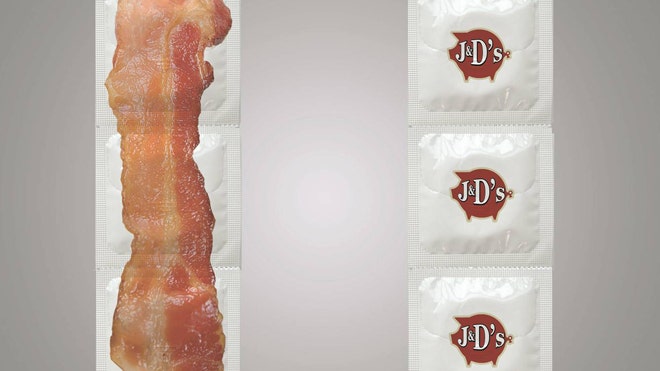
Company has introduced Bacon Condoms that claims to "make your meat look like meat." -


Company has introduced Bacon Condoms that claims to "make your meat look like meat." - 


I don't think this what Bill Gates had in mind when he offered $100,000 to someone to invent the next generation condom.
Just when you though the bacon fad was fizzling out, J&D's Foods --the same Seattle-based company that brought us the bacon coffin and bacon mayonnaise (all real products) -- now has introduced Bacon Condoms that claims to "make your meat look like meat."
As an added bonus, each condom is coated with its very own J&D’s baconlube.
From it press release: "Truly the new standard of animal protein themed prophylactics Bacon Condoms are proudly Made in America of the highest quality latex and rigorously tested to help ensure the utmost reliability and safety for when you’re makin’ Bacon."
And just when you hoped America's bacon fad was dying out, the company is also releasing  Bacon Sunscreen. 
Why?  According to the release, "science has shown us that 10 out of 10 people prefer the smell of Bacon to coconut, which makes this the most anticipated new product of the summer."
Please, put a fork in it.


Read more: - 

MYSTERY MEAT: UK takeout's lamb curry has no lamb... - Dog or Cat Meat Suspected -


MYSTERY MEAT: UK takeout's lamb curry has no lamb... - Dog or Cat Meat Suspected - 


An unnamed Indian takeaway has been found serving wrongly labelled meat by BBC researchers. Food experts working for a BBC3 programme had ordered an Indian lamb curry from the London restaurant but found that the meat in the curry had no trace of lamb.

Further DNA tests concluded that the meat chunks were not beef, chicken, pork, goat, horse or even human flesh, leading to speculation that the "lamb" curry contained dog or cat meat.

The Horsemeat Banquet programme, which roped in a group of young diners to challenge their prejudices about food, found that the meat  in the Indian curry was anything other than lamb.

A show spokesperson said: "The lab is unable to identify exactly which animal this meat came from."

Nutritionist Surinder Phull said: "It's absolutely terrifying because if it isn't any of the meats we know, what is it? Where has it come from? Where was it slaughtered? Was it hygienic? Was it covered in bacteria?"

The restaurant in the programme was not the only one found to be serving suspicious meat. The young diners also had doubts about food they obtained from Chinese takeaways and fast food outlets in the capital.

The beef in Chinese black bean sauce consisted largely of chicken blood and contained only tiny amounts of beef.

And a beefburger bought from a local fast food shop was analysed in the laboratory to reveal that it consisted of bovine blood, chicken scraps and a high level of chicken blood.

The only takeaway restaurant to serve authentic meat was a doner kebab shop. The lamb kebab purchased by the reseasrch team contained no trace of any other meat mixed with it.

Since the horsemeat scandal broke, the Food Standards Agency has ordered more than 5,000 tests and returned 44 positive results showing equine contents in meals..

Read more - 

Dog Runs Over Pedestrian With Car... -


Dog Runs Over Pedestrian With Car... - 


Police say a dog that was left in an unattended vehicle pushed it into drive and the car struck a pedestrian in central Pennsylvania.

West York Police say the accident happened shortly before 11:30 a.m. Tuesday and the pedestrian was found lying in the street.

The York Daily Record reports police say the car had been left running when the dog inside knocked it into gear, causing it to slowly drive away.

Police say the unnamed pedestrian tried to stop the car before it hit a parked truck, but was unsuccessful and was caught between the two vehicles. He hit his head, fell to the ground and was found unconscious.

He was treated at a hospital for his injuries.

Read more - 

Wednesday, 27 March 2013

CDC: 110,197,000 Venereal Infections in U.S.; Nation Creating New STI's Faster Than New Jobs or College Grads -


CDC: 110,197,000 Venereal Infections in U.S.; Nation Creating New STI's Faster Than New Jobs or College Grads - 


According to new data released by the federal Centers for Disease Control and Prevention, there were 19.7 million new venereal infections in the United States in 2008, bringing the total number of existing sexually transmitted infections (STIs) in the U.S. at that time to 110,197,000.

The 19.7 million new STIs in 2008 vastly outpaced the new jobs and college graduates created in the United States that year or any other year on record, according to government data. The competition was not close.

The STI study referenced by the CDC estimated that 50 percent of the new infections in 2008 occurred among people in the 15-to-24 age bracket. In fact, of the 19,738,800 total new STIs in the United States in 2008, 9,782,650 were among Americans in the 15-to-24 age bracket.

By contrast, there were 1,524,092 bachelor’s degrees awarded in the United States in the 2007-2008 school year, according to the National Center for Education Statistics. That means the total number of new STIs in 2008 outpaced the total number of new bachelor’s degrees by nearly 13 to 1, and the number of new STIs among Americans in the 15-to-24 age bracket outnumbered new bachelor’s degrees by more than 6 to 1.

While the CDC estimates that there were 19.7 million new STIs in the United States in 2008, data published by the Bureau of Labor Statistics indicated that the total number of people employed in the country actually declined by 2.9 million during that year.

The CDC said the new venereal infections contracted each year cost the nation about $16 billion.

Read more - 
http://cnsnews.com/news/article/cdc-110197000-venereal-infections-us-nation-creating-new-stis-faster-new-jobs-or

Man Charged For Hunting In A Walmart Parking Lot - bagged a 10-point white-tailed deer -


Man Charged For Hunting In A Walmart Parking Lot - bagged a 10-point white-tailed deer - 


An Indiana County man is facing several charges, after wildlife officials say he went deer hunting in a Walmart parking lot.

The Pennsylvania Game Commission says 40-year-old Arcangelo Bianco Jr., fired several rounds from a handgun at a 10-point white-tailed deer from within the Burrell Township store’s parking lot, and then bagged the animal near Old William Penn Highway.

The alleged shooting happened last November, while Bianco was shopping at the store, and then saw the buck in the parking lot.

According to charging documents, the deer ran around a corner of the store, and Bianco hopped out of his truck, gun in hand, and “began firing multiple rounds at the deer.”

Bianco faces a misdemeanor count of reckless endangerment, as well as several hunting violations, including hunting without a license, shooting on or across highways and unlawful killing or taking of big game.

A preliminary hearing has been scheduled for May 1.

Read more - 

Connecticut Priest Accused Of Selling Over $300,000 Worth Of Meth - “Monsignor Meth.” -


Connecticut Priest Accused Of Selling Over $300,000 Worth Of Meth - “Monsignor Meth.” - 


A Roman Catholic priest from Connecticut pleaded guilty to one of the charges accusing him of making more than $300,000 selling methamphetamine.

The Rev. Kevin Wallin was scheduled to appear in U.S. District Court in Hartford next week for a hearing in which he would plead guilty to conspiracy to possess with intent to distribute methamphetamine.

The filing Tuesday was obtained by The Associated Press.

Authorities say the Wallin, 61, had methamphetamine mailed to him from co-conspirators in California. He allegedly made more than $300,000 in drugs sales out of his apartment in Waterbury last year.

In some published reports, he has been nicknamed “Monsignor Meth.”

Published reports about Wallin said he also allegedly bought a head shop and adult bookstore in North Haven called Land of Oz & Dorothy’s Place to launder the money he generated from the meth sales.

Wallin is the former pastor of St. Augustine Parish in Bridgeport.

The Connecticut Post reported earlier this year that Wallin had been subjected to an investigation from the Diocese of Bridgeport in 2011, after reports of erratic behavior. Diocese officials had learned that he had been acting out sexually with men in the church rectory, the newspaper reported.

A message left with his attorney was not immediately returned.

Read more - 
http://newyork.cbslocal.com/2013/03/26/connecticut-priest-accused-of-selling-over-300000-worth-of-meth/