XIAM007

Making Unique Observations in a Very Cluttered World

Sunday, 7 April 2013

Cheney’s Halliburton Made $39.5 Billion on Iraq War -


Cheney’s Halliburton Made $39.5 Billion on Iraq War -


The accounting of the financial cost of the nearly decade-long Iraq War will go on for years, but a recent analysis has shed light on the companies that made money off the war by providing support services as the privatization of what were former U.S. military operations rose to unprecedented levels.

Private or publicly listed firms received at least $138 billion of U.S. taxpayer money for government contracts for services that included providing private security, building infrastructure and feeding the troops.  

Ten contractors received 52 percent of the funds, according to an analysis by the Financial Times that was published Tuesday.

The No. 1 recipient?

Houston-based energy-focused engineering and construction firm KBR, Inc. (NYSE:KBR), which was spun off from its parent, oilfield services provider Halliburton Co. (NYSE:HAL), in 2007.

The company was given $39.5 billion in Iraq-related contracts over the past decade, with many of the deals given without any bidding from competing firms, such as a $568-million contract renewal in 2010 to provide housing, meals, water and bathroom services to soldiers, a deal that led to a Justice Department lawsuit over alleged kickbacks, as reported by Bloomberg.

Who were Nos. 2 and 3?

Agility Logistics (KSE:AGLTY) of Kuwait and the state-owned Kuwait Petroleum Corp. Together, these firms garnered $13.5 billion of U.S. contracts.

As private enterprise entered the war zone at unprecedented levels, the amount of corruption ballooned, even if most contractors performed their duties as expected.

According to the bipartisan Commission on Wartime Contracting in Iraq and Afghanistan, the level of corruption by defense contractors may be as high as $60 billion. Disciplined soldiers that would traditionally do many of the tasks are commissioned by private and publicly listed companies.

Even without the graft, the costs of paying for these services are higher than paying governement employees or soldiers to do them because of the profit motive involved. No-bid contracting – when companies get to name their price with no competing bid – didn’t lower legitimate expenses. (Despite promises by President Barack Obama to reel in this habit, the trend toward granting favored companies federal contracts without considering competing bids continued to grow, by 9 percent last year, according to the Washington Post.)

Even though the military has largely pulled out of Iraq, private contractors remain on the ground and continue to reap U.S. government contracts. For example, the U.S. State Department estimates that taxpayers will dole out $3 billion to private guards for the government’s sprawling embassy in Baghdad.

The costs of paying private and publicly listed war profiteers seem miniscule in light of the total bill for the war.

Last week, the Costs of War Project by the Watson Institute for International Studies at Brown University said the war in Iraq cost $1.7 trillion dollars, not including the $490 billion in immediate benefits owed to veterans of the war and the lifetime benefits that will be owed to them or their next of kin.

Read more -

Saturday, 6 April 2013

As Predicted, James Holmes Was Taking Violence-Linked Antidepressant Drugs -


As Predicted, James Holmes Was Taking Violence-Linked Antidepressant Drugs - 
Gun shooting a caduceus
It likely comes as no surprise to those who have been following the disturbing trend of mass shooters over the years, but a new Los Angeles Times report has confirmed that Holmes had been taking the prescription psychotropic drugs Zoloft and Clonazepam (Klonopin) — one of which is the same drug that the Columbine shooter Eric Harris was on.
For months now the alternative news media has been predicting that Holmes was most certainly on antidepressant drugs as we know 90% of school shootings have links to psych meds, but until now it has only been announced that certain prescription medication was seized (and listed as Vicodin by some sources). Ultimately, we received a large degree of flak and downright hate for predicting that Holmes was on these drugs like to aggression and suicide, but it’s simply following a very blatant pattern.

As the LA Times reports, the following prescription medication was found:

“…prescription medication for sertraline, a generic version of Zoloft used to treat depression, panic disorder and obsessive-compulsive disorder; and Clonazepam, usually prescribed to treat anxiety and panic attacks”

In my article from when the incident happened, I immediately wrote a piece about how Holmes was most definitely on hardcore pharmaceuticals based on previous trends. At the time, it was being reported that he was taking Vicodin, but there was no doubt in my mind that he was on at least one antidepressant-type drug. I’ve since updated the piece with a link to the confirmation, but you can see in many of the comments individuals were very doubtful that Holmes was on any type of drug.

From my 2012 article Follow the Trend: Batman Shooter James Holmes Was On Hardcore Pharmaceutical Drugs:

Like virtually all massacre shooters before him, there is no doubt that the notorious Batman shooter James Holmes was  taking hardcore pharmaceutical drugs.

As more information comes out on the case, it will likely reveal an increasingly deep history of prescription drug abuse on behalf of Holmes. Just as the Columbine incident continued to develop into a horrific story of drug abuse and an obsession with mind alteration, it appears this case will follow a similar trend.

Prescription drug abuse that is found with antidepressants, that even at normal levels have been linked to violence, suicide, and aggression.

Side effects for the baseline drug Prozac alone include:

Suicidal behavior
Suicidal thoughts
Violent actions and reckless behavior

And once again, these were side effects that up until 2005, when Harvard psychiatrist Martin Teicher blew the whistle on the cover up, were completely hidden from the public. As detailed in the USA Today article on the subject, Teicher explains how Prozac manufacturer Eli Lilly & Co. lied for 15 years denying the very real link between Prozac and suicide. In his own words, Teicher said that the public was being treated like ”guinea pigs” in a mass experiment.

And the Klonopin Holmes was on is even more dangerous, and as Paul Joseph Watson details, has been called the world’s “deadliest drug” by certain publications. It has been linked to substantial aggressive and violent behavior, and that’s just the beginning.

People and websites like Mike Adams of NaturalNews, Alex Jones & crew of Infowars, World Net Daily, Lew Rockwell, and myself have all done the research and held their ground on the issue even amid the ‘political correct’ assault over the issue in which people actually decided to attack us over publishing the trends. And now, these websites are enjoying record traffic and credit as they reveal their predictions were 100% accurate.

Meanwhile, Big Pharma continues to pump these drugs out and promote them for young children. Yet no one blames Big Pharma for providing a potential ‘tipping point’ for these deranged individuals.

Read more - 

50 Ways to Starve the Beast -


50 Ways to Starve the Beast - 


A term coined in 1985 by an unnamed staffer of the Reagan administration was “Starve the Beast”. This referred to a fiscally conservative political strategy to cut government spending by paying less in taxes. So, in the original sense, “the Beast” was the government, and people were to starve the beast by spending less and using loopholes, therefore paying less in taxes.

These days the Beast has a lot more tentacles than just the government. The system now consists of the government and all aspects of Big Business. Big Agri, Big Pharma, Big Medicine, Big Food, Big Banking and Big Oil, to name a few. It seems that now it’s the Beast doing the starving, as small businesses close because they can’t compete with Wal-Mart, the family farm is on it’s way out because it can’t compete with the huge, subsidized Monsanto mega-farms, people are going bankrupt because they can’t pay the outrageous medical bills…

Perhaps it’s time for another financial revolution – one where people group together and use the power of the boycott to starve all the arms of this Beast that would swallow us whole. If we vote with our dollars, eventually there will, of a necessity, be a paradigm shift that returns us to simpler days, when families that were willing to work hard could make a living without selling their souls to the corporate monoliths.

Every penny you spend with small local businesses is a penny that the big box stores won’t have. Everything that you buy secondhand or barter for is an item on which you won’t pay sales tax. Disassociate yourself completely with “the system” that is making Western civilization broke, overweight and unhealthy. Starve the Beast by taking as many of these steps as possible…

Grow your own food (this starves Big Agri and Big Pharma both)
Shop at local businesses with no corporate ties
Use natural remedies instead of pharmaceuticals whenever possible
Homeschool your children
Walk or bike instead of driving when possible
Get care from naturopaths and healers instead of doctors
Make paper logs from scraps for free heat if you have a wood-burning fireplace or stove
Boycott all processed foods
Shop at local farmer’s markets
Boycott corporate stores: Wal-Mart, Costco, Best Buy, Home Depot
Give vouchers as gifts for an evening of babysitting, a homemade meal, walking the dog, doing a repair, or cleaning
Join a CSA or farm co-op
Ditch television (and all the propaganda and commercials)
Participate in the barter system - if no money changes hands, no tax can be added
Buy secondhand from yard sales, Craigslist and thrift stores
Sell your unwanted goods by having a yard sale or putting an ad on Craigslist
Repair things instead of replacing them
Avoid fast food restaurants and chain restaurants
Dine at locally owned establishments if you eat out
Brew your own beer and wine
Read a book, purchased second-hand or borrowed
Grow or gather  medicinal herbs
Give homemade gifts
Attend free local activities: lectures, concerts, play days at the park, library events
Dumpster dive
Play outside: hike, bike, picnic
Mend clothing
Invite someone over for dinner instead of meeting at a restaurant
Throw creative birthday parties at home for your kids instead of renting a venue
Camp instead of staying at a hotel
Bring your coffee with you in a travel mug
Do all of your Christmas shopping with small local businesses and artisans
Reduce your electricity usage with candles, solar power and non-tech entertainment
Drop the thermostat and put on a sweater
Bring your snacks and drinks in a cooler when you go on a road trip
Stay home - it’s way easier to avoid temptation that way
Pack lunches for work and school
Make delicious homemade treats as a hostess gift
Close your bank account or at the very least, strictly limit your balance
Visit u-pick berry patches and orchards, then preserve your harvest for the winter
Use precious metals stored at home as your savings account
Raise backyard chickens for your own eggs
If you are a smoker, roll your own cigarettes – if possible go one step further and grow tobacco
Live in a smaller, more efficient home
Use solar power for lighting or cooking
Collect rainwater for use in the garden
Learn to forage
Buy heavy, solid, handmade furniture instead of the flimsy imported stuff
At the holidays, focus on activities and traditions instead of gifts. Go for a walk or drive through the neighborhood to look at lights, get into your PJs and watch a special movie together on Christmas Eve and make certain treats that can always be expected
Make your own bath and body products using pure ingredients like coconut oil, essential oils, and herbal extracts
How do you Starve the Beast? Please share your suggestions below…

Read more - 

US Secretly Deploys B-1 Strategic Bombers, E-6 "Doomsday" Planes Near North Korea -


US Secretly Deploys B-1 Strategic Bombers, E-6 "Doomsday" Planes Near North Korea - 


First the US fanfared the placement of two F-22 Raptors in the Osan airbase of South Korea. Then it demonstratively launched a B-2 stealth bomber on a training mission over a South Korean gunnery range. Then it deployed an anti-ballistic missile defense system to Guam and positioned two guided-missile destroyers in the waters near Korea. And now, courtesy of the Aviationist, we learn that the Pentagon has escalated once more in an ongoing cat and mouse game with North Korea, of who blinks first, and dispatched several B-1 ("Bone") Lancer strategic long-range bombers to Andersen Air Force Base in Guam. What is different this time, however, is that unlike the previous very public and widely trumpeted reciprocal escalation steps, this particular deployment has been kept secret from the public (at least the broader public), "a fact that could be the sign that the U.S. is not only making symbolic moves (as the above mentioned ones), but it is preparing for the worst scenario: an attack on North Korea."

How has the Aviationist learned this?

From his station in Amarillo, Texas, author, investigative journalist, technologies expert Steve Douglass heard something interesting. In a message he sent us on Facebook he said:

“Late last night I monitored “DARK flight of seven” on PRIME (311.000 MHZ STRATCOM PRIMARY) asking for current weather for UAM [airport code for Guam - Andersen Air Force Base]. On the frequency of 251.100 Mhz,DARK flight also was calling for “GASSR 11 and GASSR 12? (KC-135s)  for “Tanker drag to BAB [Beale AFB, California]“.

“Dark” is the standard radio callsign for the 7th Bomb Wing’s B-1s based at Dyess AFB, near Abilene, Texas.

Even if U.S. bombers routinely deploy to Guam (where at least two B-2s are reportedly already based), the fact that seven “Bones” were apparently moving together is something a bit unusual, even if they were not going to Andersen AFB (they might need the weather report for UAM because it was an alternate airfield or simply a stopover on their way to somewhere else).

Actually, it’s also weird that some many big bombers were flying together (as the “flight of seven” heard by Douglass seems to suggest) since a standard ferry flight of multiple planes would normally see the aircraft move individually. And, another strange thing is that the pilot talked about their destination in the clear: if they wanted it to be secret, they would speak on secure radios.

Nevertheless, this might have been a non-standard deployment; a move ordered hours after U.S. satellites and spyplanes from South Korea and Japan had spotted North Korean missiles being readied for launch.
What is even more curious is that instead of merely serving as very expensive deterrence props, the squadron has a very offensive role, and is preparing for attack:

Earlier [Douglass] had intercepted an interesting communication off a military satellite in which an Ellsworth AFB’s B-1B, callsign “Slam 1?, was training to hit a “missile facility” in Snyder, Texas.

A practice run for a mission in the DPRK with a school bus depot standing in for the real thing?

Maybe.

American B-1 bomber pilots have reportedly shifted their training programs, focusing on in East Asia, more than Afghanistan and the Middle East. And, above all, any training mission has many similarities with actual sorties that would be flown against a real enemy in combat.

Anyway, Douglass has recorded an audio snippet of the exercise (available here). Based on the coordinates for Snyder, Texas here‘s the target on Google Maps.
Finally, and most disturbing, is that another aircraft also in the process of deployment is none other than the E-6 Mercury "Doomsday" plane, which are among the pinnacle in US Airforce nuclear war preparedness, tasked with "providing command and control of U.S. nuclear forces should ground-based control become inoperable" and whose core functions include conveying instructions from the National Command Authority to fleet ballistic missile submarines and also to further command post capabilities and control of land-based missiles and nuclear-armed bombers.

You can read more about the military air activity recently monitored by Steve Douglass in an extremely interesting article he posted on his blog that not only summarize the contents of the messages he sent to The Aviationist, but provides some more details about the alleged overseas deployment of E-6 Mercury “doomsday” planes from Tinker AFB, Oklahoma.
 

Perhaps to Kim Jong-un the military escalation to nuclear war is only one big joke, but to the US it is increasingly appearing very serious. And perhaps this is precisely what the Pentagon wanted all along?

Read more - 
http://www.zerohedge.com/news/2013-04-05/us-secretly-deploys-b-1-strategic-bombers-e-6-doomsday-planes-near-north-korea

NASA to lasso an Asteroid, bring it closer, and park it near the moon for astronauts to explore -


NASA to lasso an Asteroid, bring it closer, and park it near the moon for astronauts to explore - 


NASA is planning for a robotic spaceship to lasso a small asteroid and park it near the moon for astronauts to explore, a top senator said Friday.
The ship would capture the 500-ton, 25-foot asteroid in 2019. Then using an Orion space capsule, a crew of about four astronauts would nuzzle up next to the rock in 2021 for spacewalking exploration, according to a government document obtained by The Associated Press.
Sen. Bill Nelson, D-Fla., said the plan would speed up by four years the existing mission to land astronauts on an asteroid by bringing the space rock closer to Earth.
Nelson, who is chairman of the Senate science and space subcommittee, said Friday that President Barack Obama is putting $100 million in planning money for the accelerated asteroid mission in the 2014 budget that comes out next week. The money would be used to find the right small asteroid.
"It really is a clever concept," Nelson said in a press conference in Orlando. "Go find your ideal candidate for an asteroid. Go get it robotically and bring it back."
This would be the first time ever humanity has manipulated a space object in such a grand scale, like what it does on Earth, said Robert Braun, a Georgia Institute of Technology aerospace engineering professor who used to be NASA's chief technology officer.
"It's a great combination of our robotic and human capabilities to do the kind of thing that NASA should be doing in this century," Braun said.
Last year, the Keck Institute for Space Studies proposed a similar mission for NASA with a price tag of $2.6 billion. There is no cost estimate for the space agency's version. NASA's plans were first reported by Aviation Week.
While there are thousands of asteroids around 25-feet, finding the right one that comes by Earth at just the right time to be captured will not be easy, said Donald Yeomans, who heads NASA's Near Earth Object program that monitors close-by asteroids. He said once a suitable rock is found it would be captured with the space equivalent of "a baggie with a drawstring. You bag it. You attach the solar propulsion module to de-spin it and bring it back to where you want it."
Yeomans said a 25-foot asteroid is no threat to Earth because it would burn up should it inadvertently enter Earth's atmosphere. These types of asteroids are closer to Earth — not in the main asteroid belt between Jupiter and Mars. They're less than 10 million miles away, Braun said.
"It's probably the right size asteroid to be practicing on," he said.
A 25-foot asteroid is smaller than the size rock that caused a giant fireball that streaked through the sky in Russia in February, said Apollo 9 astronaut Rusty Schweickart, head of the B612 Foundation, a nonprofit concerned about dangerous space rocks.
The robotic ship would require a high-tech solar engine to haul the rock through space, something that is both cutting-edge and doable, Braun said. Then NASA would use a new large rocket and the Orion capsule — both under development — to send astronauts to the asteroid.
There would be no gravity on the asteroid so the astronauts would have to hover over it in an extended spacewalk.
Exploring the asteroid "would be great fun," Schweickart said. "You'd have some interesting challenges in terms of operating in an environment like that."
Nelson said the mission would help NASA develop the capability to nudge away a dangerous asteroid if one headed to Earth in the future. It also would be training for a future mission to send astronauts to Mars in the 2030s, he said. But while it would be helpful for planetary defense, "that's not your primary mission," Schweickart said.
George Washington University Space Policy Institute Director Scott Pace, a top NASA official during the George W. Bush administration, was critical of the plan, saying it was a bad idea scientifically and for international cooperation.
Instead, NASA and other countries should first join forces for a comprehensive survey of all possible dangerous space rocks, Pace said.
The government document describing the mission said it would inspire because it "will send humans farther than they have ever been before."

Read more -

21 Statistics About The Explosive Growth Of Poverty In America That Everyone Should Know -


21 Statistics About The Explosive Growth Of Poverty In America That Everyone Should Know - 


If the economy is getting better, then why does poverty in America continue to grow so rapidly?  Yes, the stock market has been hitting all-time highs recently, but also the number of Americans living in poverty has now reached a level not seen since the 1960s.  Yes, corporate profits are at levels never seen before, but so is the number of Americans on food stamps.  Yes, housing prices have started to rebound a little bit (especially in wealthy areas), but there are also more than a million public school students in America that are homeless.  That is the first time that has ever happened in U.S. history.  So should we measure our economic progress by the false stock market bubble that has been inflated by Ben Bernanke’s recklessmoney printing, or should we measure our economic progress by how the poor and the middle class are doing?  Because if we look at how average Americans are doing these days, then there is not much to be excited about.  In fact, poverty continues to experience explosive growth in the United States and the middle class continues to shrink.  Sadly, the truth is that things are not getting better for most Americans.  With each passing year the level of economic suffering in this country continues to go up, and we haven’t even reached the next major wave of the economic collapse yet.  When that strikes, the level of economic pain in this nation is going to be off the charts.
The following are 21 statistics about the explosive growth of poverty in America that everyone should know…
1 – According to the U.S. Census Bureau, approximately one out of every six Americans is now living in poverty.  The number of Americans living in poverty is now at a level not seen since the 1960s.
2 – When you add in the number of low income Americans it is even more sobering.  According to the U.S. Census Bureau, more than 146 million Americans are either “poor” or “low income”.
3 – Today, approximately 20 percent of all children in the United States are living in poverty.  Incredibly, a higher percentage of children is living in poverty in America today than was the case back in 1975.
4 – It may be hard to believe, but approximately 57 percent of all children in the United States are currently living in homes that are either considered to be either “low income” or impoverished.
5 – Poverty is the worst in our inner cities.  At this point, 29.2 percentof all African-American households with children are dealing with food insecurity.
6 – According to a recently released report, 60 percent of all children in the city of Detroit are living in poverty.
7 – The number of children living on $2.00 a day or less in the United States has grown to 2.8 million.  That number has increased by 130 percent since 1996.
8 – For the first time ever, more than a million public school students in the United States are homeless.  That number has risen by 57 percent since the 2006-2007 school year.
9 – Family homelessness in the Washington D.C. region (one of the wealthiest regions in the entire country) has risen 23 percent since the last recession began.
10 – One university study estimates that child poverty costs the U.S. economy 500 billion dollars each year.
11 – At this point, approximately one out of every three children in the U.S. lives in a home without a father.
12 – Families that have a head of household under the age of 30 have a poverty rate of 37 percent.
13 – Today, there are approximately 20.2 million Americans that spend more than half of their incomes on housing.  That represents a 46 percent increase from 2001.
14 – About 40 percent of all unemployed workers in America have been out of work for at least half a year.
15 – At this point, one out of every four American workers has a job that pays $10 an hour or less.
16 – There has been an explosion in the number of “working poor” Americans in recent years.  Today, about one out of every fourworkers in the United States brings home wages that are at or below the poverty level.
17 – Right now, more than 100 million Americans are enrolled in at least one welfare program run by the federal government.  And that does not even include Social Security or Medicare.
18 – An all-time record 47.79 million Americans are now on food stamps.  Back when Barack Obama first took office, that number was only sitting at about 32 million.
19 – The number of Americans on food stamps now exceeds the entire population of Spain.
20 – According to one calculation, the number of Americans on food stamps now exceeds the combined populations of “Alaska, Arkansas, Connecticut, Delaware, District of Columbia, Hawaii, Idaho, Iowa, Kansas, Maine, Mississippi, Montana, Nebraska, Nevada, New Hampshire, New Mexico, North Dakota, Oklahoma, Oregon, Rhode Island, South Dakota, Utah, Vermont, West Virginia, and Wyoming.”
21 – Back in the 1970s, about one out of every 50 Americans was on food stamps.  Today, close to one out of every six Americans is on food stamps.  Even more shocking is the fact that more than one out of every four children in the United States is enrolled in the food stamp program.
Unfortunately, all of these problems are a result of our long-term economic decline.  In a recent article for the New York Times, David Stockman, the former director of the Office of Management and Budget under President Ronald Reagan, did a brilliant job of describing how things have degenerated over the last decade…
Since the S&P 500 first reached its current level, in March 2000, the mad money printers at the Federal Reserve have expanded their balance sheet sixfold (to $3.2 trillion from $500 billion). Yet during that stretch, economic output has grown by an average of 1.7 percent a year (the slowest since the Civil War); real business investment has crawled forward at only 0.8 percent per year; and the payroll job count has crept up at a negligible 0.1 percent annually. Real median family income growth has dropped 8 percent, and the number of full-time middle class jobs, 6 percent. The real net worth of the “bottom” 90 percent has dropped by one-fourth. The number of food stamp and disability aid recipients has more than doubled, to 59 million, about one in five Americans.
For the last couple of years, the U.S. economy has experienced a bubble of false hope that has been produced by unprecedented amounts of government debt and unprecedented money printing by the Federal Reserve.
Unfortunately, that bubble of false hope is not going to last much longer.  In fact, we are already seeing signs that it is getting ready to burst.

For example, initial claims for unemployment benefits shot up to385,000 for the week ending March 30th.
That is perilously close to the 400,000 “danger level” that I keep warning about.  Once we cross the 400,000 level and stay there, it will be time to go into crisis mode.
In the years ahead, it is going to become increasingly difficult to find a job.  Just the other day I saw an article about an advertisement for a recent job opening at a McDonald’s in Massachusetts that required applicants to have “one to two years experience and a bachelor’s degree“.
If you need a bachelor’s degree for a job at McDonald’s, then what in the world are blue collar workers going to do when the competition for jobs becomes really intense once the economy experiences another major downturn?

Read more -

97% Of February Consumer Credit Is Student And Car Loans -


97% Of February Consumer Credit Is Student And Car Loans - 


The releveraging deleveraging continues. While US consumers barely dare to touch their credit cards, as they did in February when just $533 million in revolving consumer credit was added, they continue to take advantage of Federal largesse to take out student and car loans for the maximum amount possible, and as expected in February of the $18.1 billion in total credit taken out, a whopping 97% was non-revolving, or mostly student and GM loans (recall that now one can "finance" a car using their shotgun as collateral). To show just how dramatic the shift toward Uncle Sam as bank of only recourse for the US consumer has become, consider that in the past 12 months, of the $158.8 billion in total consumer credit issued, just $6 billion is credit card based. The remainder: debt that will never be repaid because those who take it out use it to finance such things as their education in vocational school (and iPads, tattoos, lap dances, semiautomatic guns and booze of course), as well as various GM cars that amortise by about 100% the second they are driven off the car lot.

Spot the student and car loan components of total credit:


Read more -

Friday, 5 April 2013

Is It Beginning? Biggest JGB Price Collapse In Over 10 Years Triggers TSE Circuit Breakers -


Is It Beginning? Biggest JGB Price Collapse In Over 10 Years Triggers TSE Circuit Breakers - 


Just over 4 hours ago we discussed the stunning collapse in 10Y Japanese bond yields. Since then - things have taken a very dramatic turn for the worse for bonds. 10Y JGB yields have exploded higher. The move from 32bps to 65bps triggered circuit breakers on the Tokyo Stock Exchange in JGB Futures trading as JGB prices plunged by their largest amount since September 2002. We can only imagine there is liquidations galore occurring given the massive outsize moves we are seeing in Japanese bonds, stocks, FX, swaps, and CDS. Did the BoJ just lose control?

 Now that is a reversal!!


Read more - 
http://www.zerohedge.com/news/2013-04-05/it-beginning-biggest-jgb-price-collapse-over-10-years-triggers-tse-circuit-breakers

Thursday, 4 April 2013

As economy flails, debtors' prisons thrive -


As economy flails, debtors' prisons thrive - 


Thousands of Americans are sent to jail not for committing a crime, but because they can't afford to pay for traffic tickets, medical bills and court fees. 

If that sounds like a debtors' prison, a legal relic which was abolished in this country in the 1830s, that's because it is. And courts and judges in states across the land are violating the Constitution by incarcerating people for being unable to pay such debts.

Ask Jack Dawley, 55, an unemployed man in Ohio who between 2007 and 2012 spent a total of 16 days in jail in a Huron County lock-up for failing to pay roughly $1,500 in legal fines he'd incurred in the 1990s. The fines stemmed from Dawley's convictions for driving under the influence and other offenses. After his release from a Wisconsin correctional facility, Dawley, who admits he had struggled with drugs and alcohol, got clean. But if he put his substance problems behind him, Dawley's couldn't outrun his debts. 

Struggling to find a job and dealing with the effects of a back injury, he fell behind on repayments to the municipal court in Norwalk, Ohio. He was arrested six years ago and sent to jail for not paying his original court fines. Although Dawley was put on a monthly payment plan, during his latest stint behind bars in 2012 the court ordered him to pay off his entire remaining debt.

" I called my brother, and they told him I have to pay off the whole fine in order for me to get out," he said. "That was $900. So I sat my whole 10 days [in jail.]"

Such stories are by no means unusual. Rather, they reflect a justice system that in effect criminalizes poverty. "It's a growing problem nationally, particularly because of the economic crisis," said Inimai Chettiar, director of the justice program at New York University School of Law's Brennan Center for Justice.

Roughly a third of U.S. states today jail people for not paying off their debts, from court-related fines and fees to credit card and car loans, according to the American Civil Liberties Union. Such practices contravene a 1983 United States Supreme Court ruling that they violate the Constitutions's Equal Protection Clause.

Some states apply "poverty penalties," such as late fees, payment plan fees and interest, when people are unable to pay all their debts at once. Alabama charges a 30 percent collection fee, for instance, while Florida allows private debt collectors to add a 40 percent surcharge on the original debt. Some Florida counties also use so-called collection courts, where debtors can be jailed but have no right to a public defender. In North Carolina, people are charged for using a public defender, so poor defendants who can't afford such costs may be forced to forgo legal counsel. 

The high rates of unemployment and government fiscal shortfalls that followed the housing crash have increased the use of debtors' prisons, as states look for ways to replenish their coffers. Said Chettiar, "It's like drawing blood from a stone. States are trying to increase their revenue on the backs of the poor."

In Dawley's home state of Ohio, the local chapter of the ACLU announced today that it had found conclusive evidence of such polices in 7 of 11 counties in the state that it examined over the course of a year-long investigation. Although debtors' prisons are unconstitutional and prohibited by Ohio law, poor defendants are routinely jailed for failing to pay court fines, the group said in a report.

Municipal and so-called mayors' courts -- Ohio is one of two states in the U.S. where mayors can administer the law, even if they aren't licensed attorneys -- also commonly do not give defendants like Dawley a hearing or inform them of their rights to counsel, as required by law.  

"They didn't give you the opportunity to say you couldn't pay," Dawley said of his time in court. "They just gave out 10 day sentences.... There was nothing about your finances. Either you plead guilty, not guilty or no contest. They give you a jail date and put you on a payment plan, and if you don't make the payment plan you're going to jail."

In so doing, courts fail to make a crucial distinction between defendants who have the means to pay their debts but refuse to do so, and those who are too poor to repay. That failure derives in large part from the lack of a consistent legal standard for determining willful nonpayment of such debts. As a result, while a judge in one state may take into account that a person on food stamps is financially unable to pay court costs, a judge across the state line might sentence that same individual to 10 days in the clink. 

"If you don't have resources for an attorney or can't afford other fees associated with court, you get a different brand of justice," said Mike Brickner, director of communications and public policy at the ACLU of Ohio, noting that such practices are "rampant" in the state. "And with the economic downturn over the last 10 years, we've seen an increase and resurgence in debtors' prisons."

In another case the group uncovered in Ohio, a mother of three was imprisoned for 10 days for failing to pay $540 in fines and costs related to a conviction for driving with a suspended license. And as in other cases where the indigent are jailed, taxpayers ended up footing part of the bill. The total cost of arresting and incarcerating her amounted to nearly $1,000. 

Read more - 

Target offends shoppers after it uses 'Manatee' to describe Plus-size Dress -


Target offends shoppers after it uses 'Manatee' to describe Plus-size Dress - 

View image on Twitter
Talk about a fashion faux pas. 
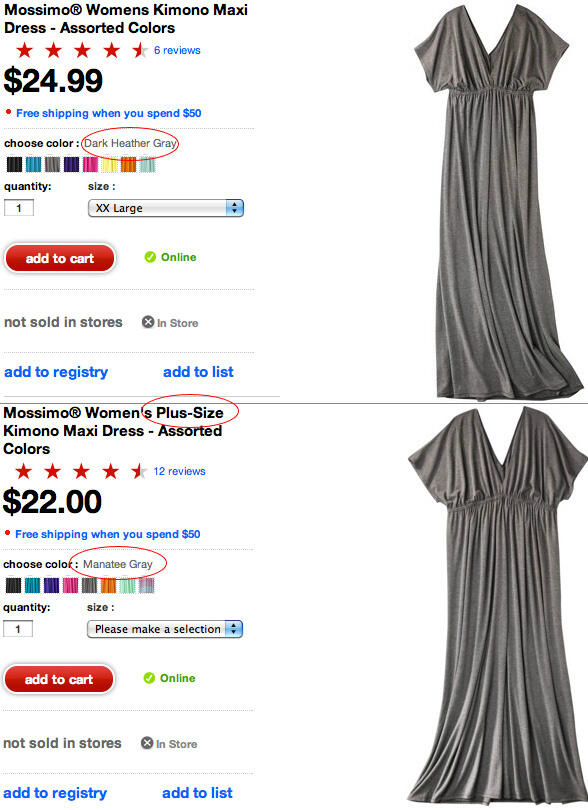
Target caused quite an uproar this week when they named the color of a gray plus-size dress for sale on their website “Manatee Gray.”
The same dress in regular sizes was labeled “Dark Heather Gray,” leaving online shoppers wondering just what the retailer was trying to imply with their word choice.
The color switch-a-roo was noticed by online shopper Susan Clemens, who promptly captured images of the color titles and tweeted it at Target.


Read more: -